0Investigations
—Avg rating
0Sightings
0Evidence
Paranormal summary
Historical context
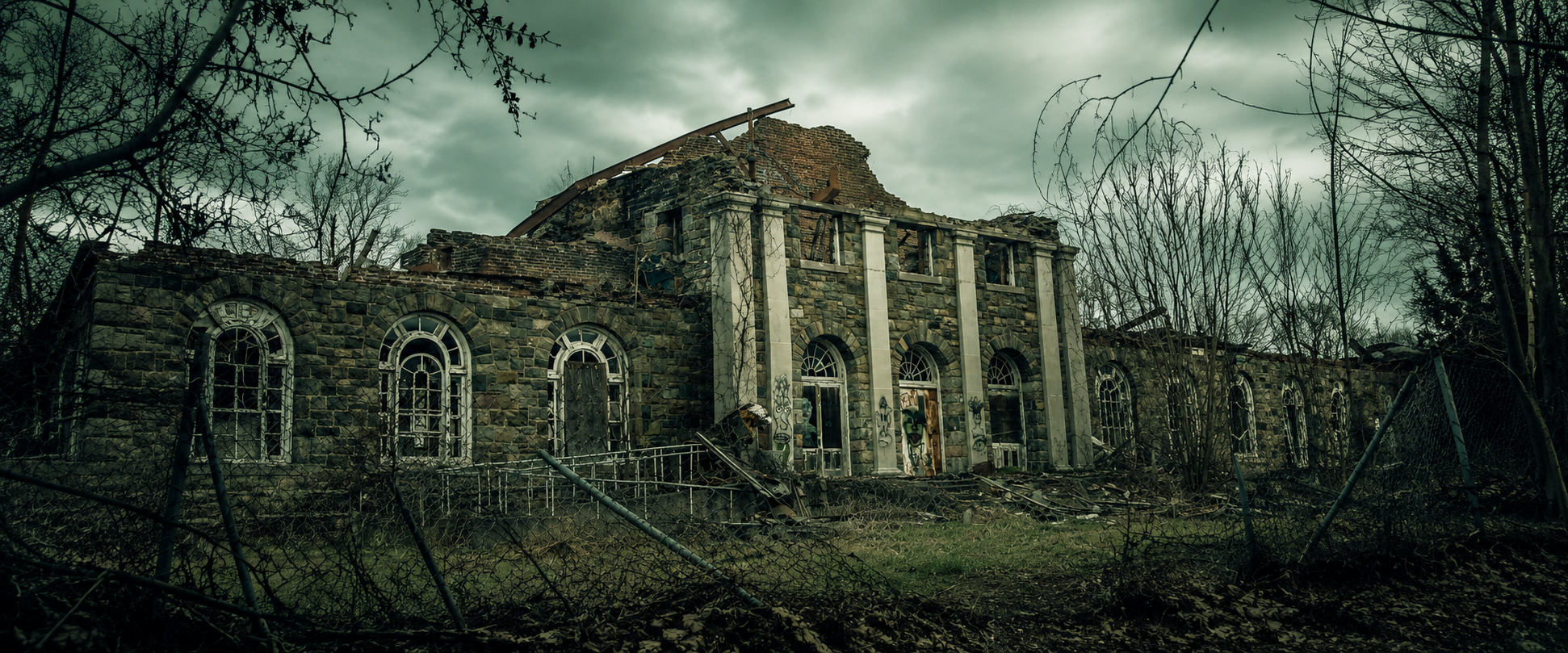
Walk the overgrown paths of Letchworth long enough and the silence starts to feel less like quiet and more like held breath. Hundreds died here — many of them children — and hundreds were buried in unmarked graves that the woods have since swallowed whole. Visitors and investigators alike swear they've felt unseen hands, heard a small voice murmur "I'm cold" from an empty ward, or caught the flicker of lights in buildings that haven't had power in decades. The suffering stored in these walls didn't seem to leave with the last patient in 1996. It just stayed.
Historical context
Opened in 1911 on a sweeping 2,362-acre campus and named for reformer William Pryor Letchworth, the Village was designed as a model institution for the mentally and physically disabled — progressive, even utopian, by the standards of its day. By the 1920s the record tells a grimmer story: overcrowding, neglect, abuse, and eventually human medical trials, including the first polio vaccine test on residents in 1950. It limped along until 1996, leaving behind crumbling buildings, a cemetery in use from 1914 to 1967, and a reputation that no amount of overgrowth has managed to bury.
Rate this haunt
Be the first to rate Letchworth Village Abandoned Mental Hospital .
★★★★★
Sign in to rate this haunt.
Location info
TypeHospital
CityThiells
StateNew York
CountryUS
AddressLetchworth Village, Thiells, NY 10984 (College Road area, Rockland County — no single street address; campus spans multiple acres off College Road and Thiells–Mount Ivy Road)
Accesspublic
Inv-friendlyyes
Region tags
Town of HaverstrawNew York
Known entities
👻
The Children of the Wards
Collective presence of child spirits reported in former residential buildings; investigators claim to have captured a child's voice saying "I'm cold" on audio.
👻
The Unmarked Dead
Residual presence associated with the onsite cemetery's hundreds of unclaimed, unmarked graves, active from 1914–1967; felt as cold gusts and whispered pleas.
👻
The Shadow Figure
A dark, human-shaped form reportedly seen moving between buildings; described by urban explorers and investigators as appearing to follow visitors.
Explore nearby
Lyndon Tracks · East BethanyLake Champlain shore near Georgia Pacific Factory · PlattsburghThe Capitol building · AlbanyBig Moose lake · Adirondack MountainsWolf Road · AlbanyIndian Falls · BasomThe Roberson Museum and Science Center · BinghamtonFederal Hill Rd. · BrewsterMarine Park · BrooklynWest of the I95 highway · BronxBuffalo Naval Park · BuffaloNaval Serviceman's Park · Buffalo